


Terraforming Mars
Twin Sails Interactive
I approached Terraforming Mars as a decision rather than a quick recommendation: is this the right digital board game for the way you actually like to play? My answer is mostly yes if you enjoy planning several turns ahead, comparing imperfect options, and watching a slow strategy become a working engine. It is much less convincing if you want a fast, casual board game that explains itself in a few minutes.
This is the digital adaptation of the well-known strategy board game, developed by Twin Sails Interactive. On Android, it sits in the board-game category, carries an Everyone age rating, and asks for a one-time price of $8.99. There are also optional in-app purchases ranging from $1.49 to $5.99 per item, so I would check the purchase screen carefully before handing the device to a child or another player.
How to decide whether Terraforming Mars suits you
The first question is not whether you like science fiction. The important question is whether you enjoy making choices whose value changes over time. A card that looks weak during the opening can become useful later, while an apparently efficient project may be a poor investment if it does not support your wider plan. I found that this constant reassessment is the heart of the experience.
The game asks you to think about Mars as a long-term project rather than a collection of isolated turns. You are trying to improve the planet while also building your own position. That creates a useful tension: helping the shared objective can move the game forward, but spending too many resources on general progress may leave your personal development behind.
That makes it a strong choice for players who like board games with an economic layer, card combinations, and gradual growth. It is also a good fit for someone who normally plays physical strategy games but wants a more convenient way to practice decisions without setting up a table. I can open it when I have enough quiet time to think, return to the same strategic question, and avoid sorting cards or tracking pieces by hand.
Related News






It is not the ideal pick for someone seeking a party game, a quick puzzle, or an immediately social experience. The digital format makes the board cleaner, but it does not remove the underlying complexity. If you usually prefer games where every turn is obvious and the result is easy to read, the early learning period may feel demanding rather than rewarding.
The opening turns reward patience more than flashy moves
My most useful early lesson was to avoid choosing cards simply because they sounded exciting. The opening is about preserving flexibility. I look for projects that can support several possible plans instead of committing too early to a narrow direction. This matters because the cards available to me can pull the game toward different priorities, and a rigid opening can make later decisions unnecessarily awkward.
A practical habit is to separate immediate value from future value. A card that produces a benefit right away may be attractive, but another card can be better if it improves the resources needed for several later actions. I also try to keep enough options available for the next round rather than spending everything as soon as I can. That small restraint often gives me more control than a dramatic first move.
Gallery
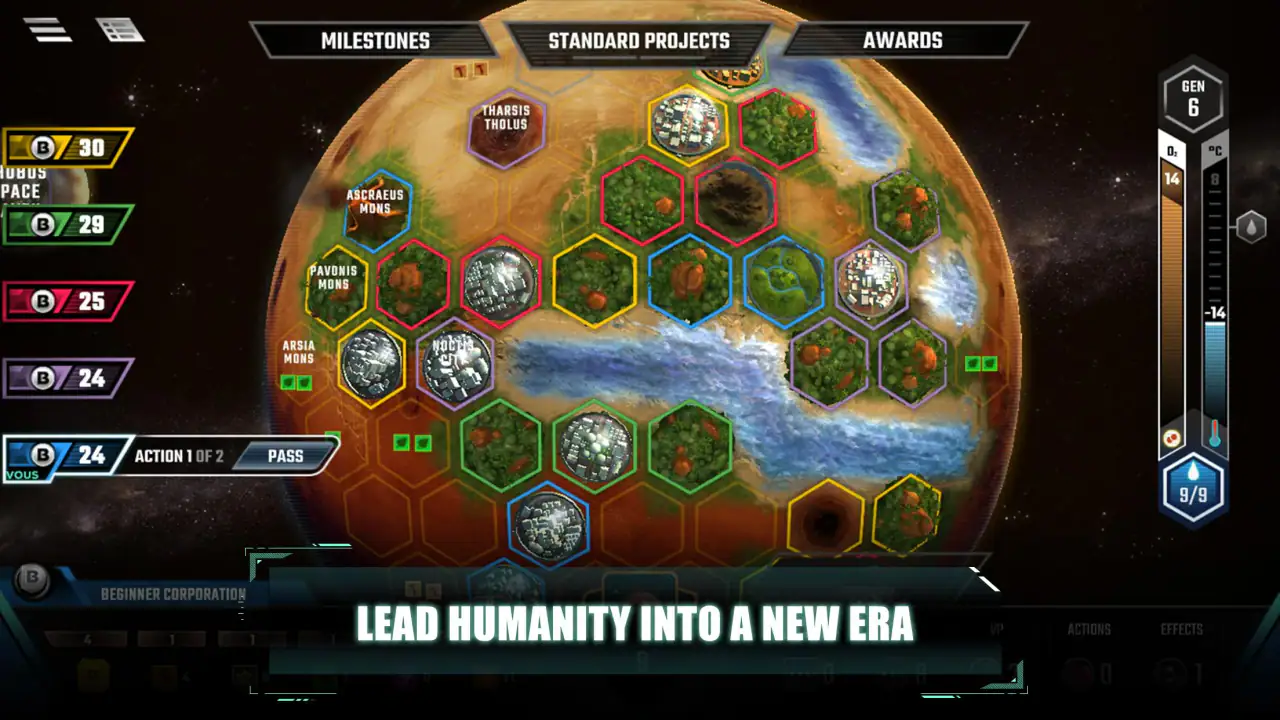
The interface helps with the bookkeeping that would otherwise slow a physical game. I can concentrate on the consequences of an action instead of manually checking every token and card interaction. Still, automation does not replace understanding. The game may show what I can do, but it cannot decide whether an action is strategically sensible in the context of my whole plan.
Why the shared objective changes every personal decision
One of the most interesting trade-offs is that the planet-wide goal and my private development are connected without being identical. Progress toward the common objective can shorten the remaining time to build an engine. That can be excellent when my position is ready, but uncomfortable when another player is benefiting more from the same progress.
I therefore pay attention to timing rather than treating every environmental improvement as automatically good. Sometimes I want to accelerate the game because my production and card combinations are already working. At other times, I prefer to develop first and let the broader project advance more slowly. This is where the adaptation feels more thoughtful than a simple card-matching game.
A useful advanced approach is to watch what other players appear to be preparing, even when the board does not reveal every detail directly. If someone is collecting the resources needed for a particular direction, I consider whether competing for that space is practical or whether I should choose a different route. Chasing the same plan can be satisfying, but it may also create a costly race that benefits neither player.
Reading the board instead of playing cards in isolation
The board is not just a place to put pieces. Placement can influence future opportunities, so I try to think about the next useful location rather than only the current reward. A move that provides a modest benefit now may be stronger if it opens a better follow-up. Conversely, taking an attractive space without a clear continuation can leave me with a board that looks productive but does little for my actual position.
This is one reason I would not recommend rushing through the tutorial or first few games. The rules become easier to remember when I connect them to a plan. I learn more from asking why an action improved my position than from memorizing a list of effects. Once that habit develops, the many choices feel less like clutter and more like a set of competing routes.
I also find it helpful to decide what I am willing to ignore. Trying to benefit from every available direction usually spreads resources too thinly. A focused plan is not always successful, but it gives me a clearer way to evaluate new cards and opportunities. When the plan stops working, I can change it deliberately instead of drifting from one attractive action to another.
Where this adaptation wins, and where another type of game may fit better
The biggest strength is convenience without turning the board game into a shallow mobile experience. The digital version handles the repetitive parts, leaving me with the decisions that make the original appealing. I do not need a large table, a long setup, or another person available at the exact moment I want to play. For a strategy fan with limited space, that is a meaningful advantage.
It also works well as a learning tool for people who are curious about modern board games but feel intimidated by a physical box full of cards and components. The app can make the structure easier to approach because the board stays organized and the game enforces the available actions. I still need to learn the reasoning behind those actions, but I spend less energy worrying about whether I have maintained the state correctly.
Another strength is the way the digital format supports experimentation. I can try a particular direction, notice where it becomes inefficient, and use that experience in the next game. That is more useful than simply copying a supposed best strategy because the game rewards adapting to the options in front of me. The result is a board game that can feel different from one session to the next even when the overall objective remains familiar.
The current version is 2.11.7.131308, and the game supports devices running Android 7.0 or later. That makes the compatibility requirement relatively approachable for many Android users, although I would still consider screen size and device comfort before buying. A dense strategy board can be tiring on a small display, especially when I am comparing several cards and planning a sequence rather than making a single quick move.
Why it is not automatically better than every alternative
Compared with lighter board games, this one asks for more attention before it becomes relaxing. A simple digital board game may be better when I have only a few spare minutes or want to play while distracted. Terraforming Mars rewards the opposite behavior: I prefer to give it a focused session so I can remember my plan and understand why the board is changing.
Compared with a traditional tabletop session, the app wins on setup and bookkeeping but loses some of the atmosphere of playing around a table. There is less natural conversation, less physical satisfaction from handling components, and no substitute for a group of friends reacting to each move in person. If the social ritual is the main reason I play board games, the physical version or another multiplayer-focused option may fit better.
Compared with a purely digital strategy game, this adaptation has a more deliberate rhythm. It is not trying to overwhelm me with constant action. The appeal is in building a position, noticing an opportunity, and deciding whether the timing is right. Players who want fast animation, reflex challenges, or a story-led campaign should look elsewhere rather than expecting this board-game structure to transform into an action game.
The average rating is 3.7 from around 9.8 thousand ratings, with about 1.3 thousand written reviews. I read that overall response as a sign that the game has a clear audience but is not universally effortless. That matches my experience: the strategic core is rewarding, while the learning curve and slower pace can divide players who want instant accessibility.
Everyday use cases that make the purchase easier to judge
For me, the strongest scenario is a quiet evening when I want a game that occupies my attention without requiring a group. I can settle into a session, test a plan, and stop thinking about it afterward with the feeling that I made meaningful choices. It is also useful for a board-game enthusiast who travels or lives in a small space and wants the structure of a substantial tabletop title without carrying components.
A second use case is learning through repetition. If I am preparing to play the physical board game with friends, the app can help me become familiar with the rhythm of production, card evaluation, and shared progress. I would not treat it as a replacement for learning the rules carefully, but it can make the first physical session less overwhelming.
A third use case is comparing decision styles with another player. Instead of simply asking who won, I can look back at the choices that shaped the result: whether one player invested too early, whether another waited too long, and which opportunities were ignored. That makes the game valuable for people who enjoy discussing strategy after the match, not just watching the final score.
What the price and optional purchases mean for the decision
The $8.99 entry price places this firmly in the premium board-game space rather than the casual free-download category. I prefer that framing because it encourages me to judge the game by its depth and replay value, not by whether it provides a few minutes of entertainment without payment. If I already know that I dislike long strategic sessions, the price will not become worthwhile simply because the game is well made.
The optional purchases, priced between $1.49 and $5.99 per item, are another reason I would decide in advance how I want to use the app. I would approach the base purchase as the starting point and avoid assuming that every additional item is necessary. For a careful buyer, the important trade-off is whether the core experience already matches your preferred pace and complexity before spending more.
There are over 100 thousand installs, so the game has reached a substantial Android audience without being presented as a mass-market casual title. I would take that as encouragement to investigate the play style rather than as a guarantee that it will suit everyone. Popularity can show that a game has a committed audience, but it cannot remove the personal question of whether its decisions feel enjoyable to you.
The cost of switching from another board game
If you are moving from a light card game, the main cost is mental adjustment. You will need to accept that a good turn may not produce an obvious reward and that a weak-looking choice can matter several rounds later. I recommend starting with a simple personal objective: learn how production, placement, and shared progress interact before trying to optimize every card.
If you are moving from a physical strategy game, the transition is easier in terms of rules but different in terms of feel. The app removes much of the manual work, which is convenient, yet it can also make the experience feel less tactile. I would give it a few sessions before deciding whether that trade-off works for you, particularly if your enjoyment normally comes from handling components and negotiating moves face to face.
If you are moving from a fast mobile game, I would not try to play it in the same way. Short, distracted sessions can make the strategic structure feel more confusing because the game depends on remembering your direction. I get more from it when I treat each session as a focused activity, even if I do not play for a very long time.
Who should buy it, and who should skip it
I recommend it to players who enjoy planning, resource management, card evaluation, and a board that develops gradually. It is especially appealing if you want a substantial solo-style digital board-game experience, a way to practice before playing at a table, or a strategy title that values decisions over reflexes.
I would be cautious if you need a very short learning curve, dislike reading and comparing options, or mainly want social conversation during a game. I would also skip it if the price of a premium purchase plus optional items feels uncomfortable before you have confirmed that this particular style is for you. Another board-game app with simpler rules may provide more immediate enjoyment in that situation.
My final recommendation is positive but specific: buy Terraforming Mars when you want a thoughtful digital board game, not merely a game to fill spare seconds. Twin Sails Interactive’s adaptation gives the original concept a convenient home on Android, and the automated bookkeeping lets me focus on the strategic trade-offs. Its slower pace, learning demands, and premium cost are real limitations, but for the right player they are part of what makes each successful plan feel earned.
After spending time with it, I see this as a game for deliberate sessions and repeated learning rather than instant gratification. The best reason to choose it is not the theme alone, but the satisfaction of turning uncertain options into a coherent plan. If that sounds like the kind of challenge you want, Terraforming Mars is a worthwhile recommendation; if you want speed, simplicity, or table-side conversation first, a lighter alternative will probably serve you better.
FAQs for Terraforming Mars
What is Terraforming Mars, and how does the game work?
Terraforming Mars is a strategic board-game adaptation in which players lead corporations competing to make Mars habitable. You manage resources, play project cards, raise oxygen and temperature levels, and place oceans or greenery on the planet. Each action affects the shared world, but your corporation also earns points through personal achievements, milestones, and long-term development.
Is Terraforming Mars suitable for beginners?
Terraforming Mars offers considerable strategic depth, so complete beginners may need a few games to understand production, card effects, and the timing of major projects. The rules are manageable once learned, and the digital version generally helps by calculating resources and applying effects automatically. Starting with the basic rules and a lower-complexity corporation can make the first experience much smoother.
Can Terraforming Mars be played offline or without other players?
Yes, Terraforming Mars includes solo play against an automated opponent or through a dedicated solo challenge, depending on the version and available modes. You can also play against computer-controlled corporations when no friends are available. However, the strongest experience usually comes from multiplayer sessions, where negotiations, competition for milestones, and changing board positions create more variety.
Does Terraforming Mars support multiplayer on Android and iOS?
The mobile version is designed to support multiplayer, allowing players to compete with friends or other users, although exact features can depend on the current app release, platform, and online service availability. Before downloading, check the store listing for supported multiplayer modes, account requirements, and compatibility. A stable internet connection may be necessary for online matches.
Is Terraforming Mars free to download, and are there additional purchases?
Terraforming Mars is generally offered as a paid game rather than a completely free experience, but pricing can vary between Android, iOS, and regional app stores. Some editions may also provide expansions or additional content as separate purchases. It is worth checking the current store page before downloading, especially if you want the full collection of corporations, cards, and gameplay variants.
Pros
- Deep strategy with many viable paths to victory.
- Excellent replay value from varied corporations and project cards.
- Faithfully captures the theme of building a habitable Mars.
- Supports solo play as well as competitive multiplayer.
- Frequent decisions make every generation feel meaningful.
Cons
- Games can take a long time
- especially with several players.
- The interface may feel dense for newcomers to the board game.
- Random card draws can strongly influence early-game progress.
- Limited interaction may disappoint players seeking direct conflict.
- Some advanced content may require extra purchases or expansions.


